

Nextflow Basics: Summary of Concepts and Feature
Contents
Notice
This text was originally translated using AI tools.
Introduction#
As the number of services handling pipeline tasks at my company increased, I needed a more efficient and systematic way to manage them. To address this, I want to summarize what I've learned about Nextflow.
Nextflow is an open-source workflow framework designed to efficiently build and manage data-intensive workflows.
It automates the process of connecting and executing each step when writing complex data analysis pipelines.
While it has been widely used in the field of bioinformatics,
it is now being utilized in various sectors that require large-scale data processing.
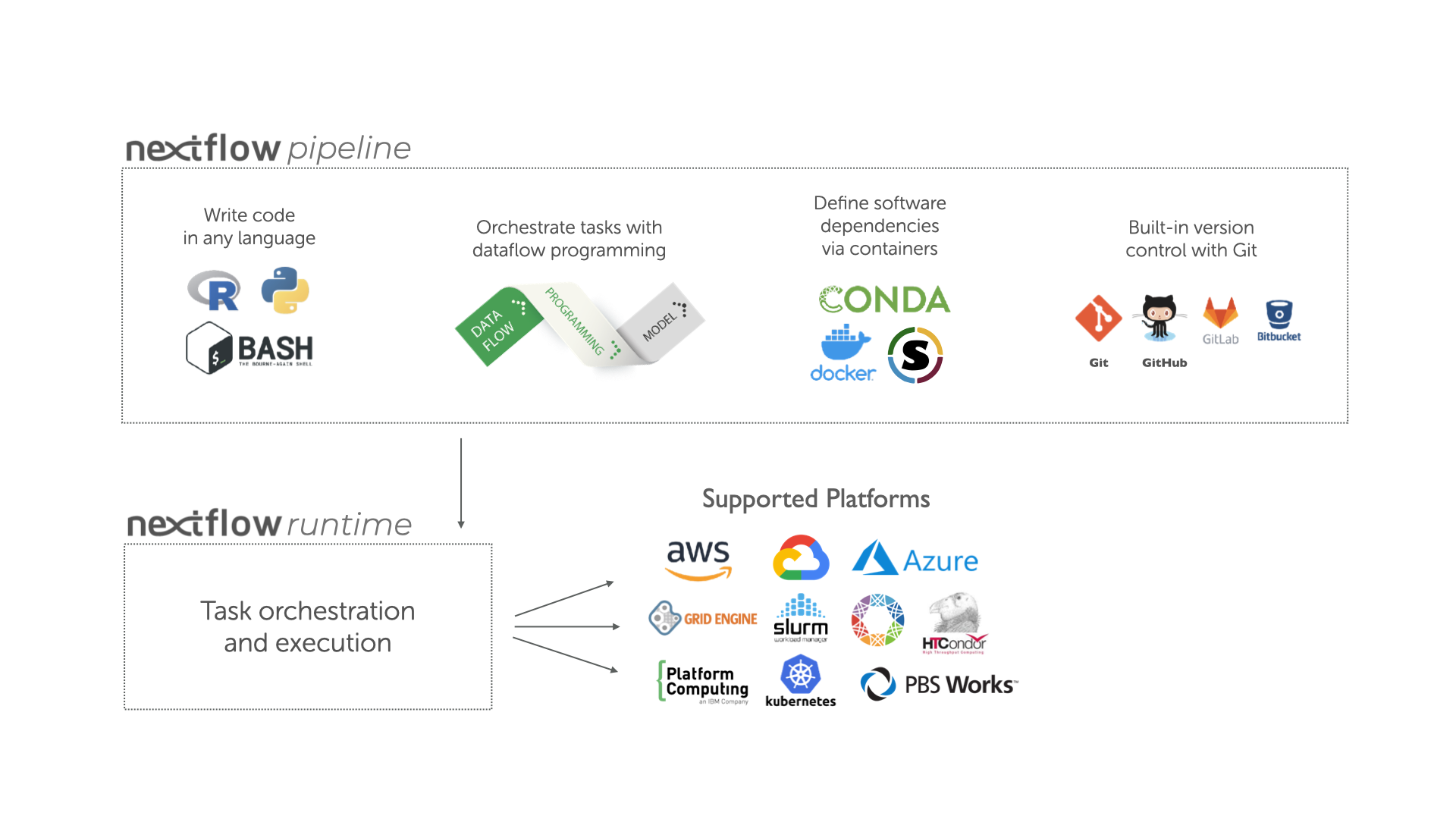 Figure 1. Overall architecture of how Nextflow is configured(Source: Nextflow.io)
Key Features#
- Reproducibility
- It integrates perfectly with Docker, Singularity, Conda, and more. By containerizing the environment itself, it guarantees identical results regardless of where it is run.
- Portability
- Code written on a local PC can be deployed to various environments (AWS Batch, Google Cloud Life Sciences, Kubernetes, etc.) without modification.
- Tip: Nextflow possesses strong portability because it is designed based on the Groovy (JVM-based) language.
- Parallelization
- If each step can be executed independently, Nextflow automatically processes them in parallel to increase task efficiency.
- Error Recovery
- If an error occurs at a specific step, you don't need to start over from the beginning.
Through the
-resumeoption, you can use cached results for successful steps and restart only from the failed portion.
- If an error occurs at a specific step, you don't need to start over from the beginning.
Through the
Process and Channel#
Nextflow fundamentally consists of the following two core concepts:
- Channel: A pathway for sending and receiving data between processes. The output of one process enters as the input for the next process through a channel.
- Process: An independent unit of work (executing scripts, processing data, etc.).
Dataflow Programming: A method where a process is executed as soon as data enters through a channel. The entire workflow is controlled by the
data flowrather than a predefined execution order.
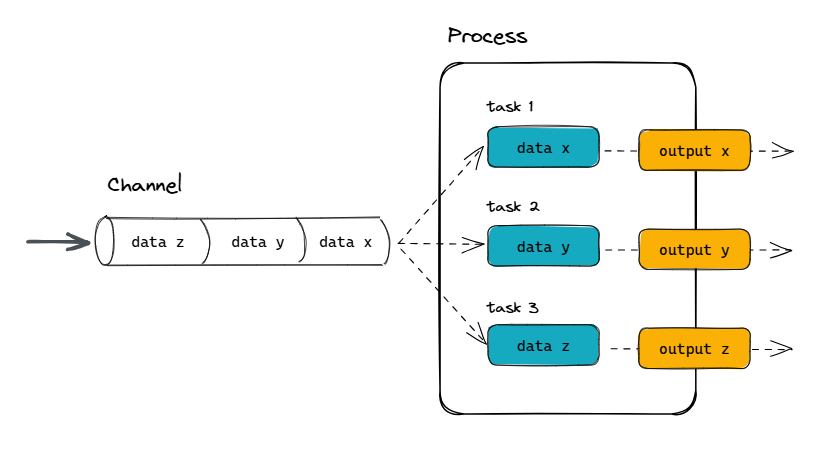 Figure 2. Data flowing through channels to execute processes (Source: Nextflow.io)
Installing Nextflow#
Installation is surprisingly simple. Since Nextflow is primarily designed for POSIX (Linux/macOS) environments, it can be installed in a Windows environment using WSL2 (Windows Subsystem for Linux).
Note that because Nextflow is Groovy-based, it requires a JRE (Java Runtime Environment), specifically Java 17 or higher at this time.
The installation commands are as follows:
# Run the installation script
curl -s https://get.nextflow.io | bash

# Grant execution permission (if necessary)
chmod +x nextflow

# Verify the installation via the info command
./nextflow info
It is convenient to move the installed
nextflowfile to a system path (PATH) like/usr/local/bin/so that you can use thenextflowcommand directly from any directory without the./prefix.
Conclusion#
Nextflow provides an "infrastructure-agnostic environment." If you have struggled
with complex dependency management and parallel processing, utilizing Nextflow seems to be a great solution.
For more detailed information or the latest updates, you can check the official website below.
- Nextflow Official Website: https://www.nextflow.io/
- Nextflow Documentation (Docs): https://www.nextflow.io/docs/latest/index.html
In the next post, I will examine how to actually execute a simple pipeline.